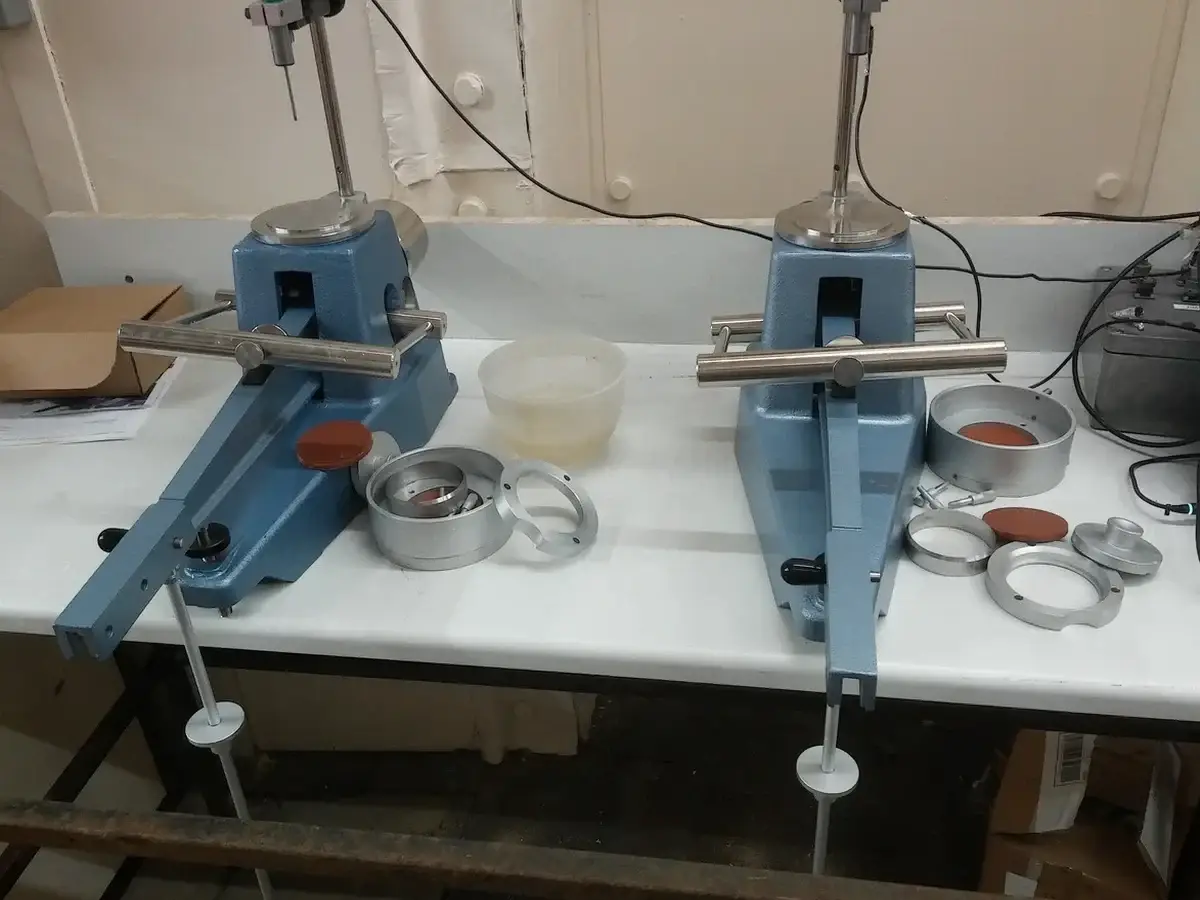
The Red River cuts right through Shreveport, leaving behind fat clay deposits that swell when wet and crack when dry. Anyone who has built near Cross Lake knows the drill. These high-plasticity clays can wreck a slab in two seasons if you do not know their numbers. That is where Atterberg limits testing comes in. We run the full suite—liquid limit, plastic limit, and plasticity index—on every sample pulled from your site. The data tells you exactly how the soil will behave under moisture changes. It feeds directly into your bearing capacity calculations. It also keeps your earthwork spec tight and defensible. When a grain-size analysis runs alongside the limits, you get a complete picture of the fines fraction. This is not academic data. It is the difference between a warranty call and a clean handover.
A plasticity index over 25 in Shreveport means you need a moisture control plan before the first footing goes in.
Process and scope
Site-specific factors
North Louisiana gets 50-plus inches of rain a year, and the summer humidity sits above 80 percent for weeks. That moisture does not just sit on the surface. It moves through the vadose zone and soaks expansive clays to depth. A foundation on high-PI soil without a moisture barrier is a foundation on a sponge. The Atterberg limits give you the number that triggers the mitigation. If the PI crosses 25, we recommend a moisture-conditioned select fill layer or a deepened perimeter beam. The cost of that mitigation is a rounding error compared to the cost of repairing differential heave. We have seen the repair bills. The lab data pays for itself before the slab is poured. A plate-load-test on the prepared subgrade confirms the modulus after treatment. That is the belt-and-suspenders approach that holds up in court and keeps homeowners out of litigation.
Standards used
ASTM D4318 – Standard Test Methods for Liquid Limit, Plastic Limit, and Plasticity Index of Soils, ASTM D2487 – Standard Practice for Classification of Soils for Engineering Purposes (Unified Soil Classification System), IBC 2021 Section 1803 – Geotechnical Investigations
Complementary services
Grain Size Distribution
Sieve and hydrometer analysis per ASTM D6913 and D7928. Quantifies sand, silt, and clay fractions. Combined with Atterberg limits, it nails the USCS group symbol without ambiguity.
Standard Proctor Compaction
ASTM D698 moisture-density relationship. Determines the optimum moisture and maximum dry density for fill. Essential when the PI dictates a moisture conditioning range.
Typical parameters
FAQ
What does an Atterberg limits test cost in Shreveport?
A standard Atterberg limits test (liquid limit plus plastic limit) runs US$50 to US$110 per sample, depending on whether a single-point or multipoint liquid limit is required. Volume pricing applies for five or more samples from the same project.
How long does it take to get results?
Standard turnaround is 48 hours from the time the sample arrives at the lab. Rush 24-hour results are available for an additional fee when the drilling crew is waiting on data to adjust the borehole depth.
What sample size do you need for the test?
We need about 200 grams of material passing the No. 40 sieve. That typically means pulling a larger bag from the split spoon or auger and letting us process it in the lab. We can also accept an undisturbed tube if the client wants a full profile.
Why do Shreveport soils have such high plasticity?
The Red River floodplain deposits are rich in montmorillonite clay minerals. These particles are extremely small and electrically active, which lets them hold a lot of water. The result is a liquid limit that can exceed 70 in the fat clays found near the river bottoms and Cross Lake.