Shreveport's growth along the Red River has always been tied to its geology. The city's development from a 19th-century river port into a modern urban center meant building on complex alluvial deposits that shift and swell with the seasons. Designing a shallow foundation here isn't just about distributing load—it’s about understanding how the underlying clay reacts to prolonged drought followed by sudden floods. Our approach integrates local geotechnical history with rigorous testing to deliver bearing capacity calculations that hold up under the Louisiana sun and the unpredictable Red River stage. Before finalizing a footing design, many local engineers pair our analysis with in-situ permeability testing to quantify drainage behavior in the fat clays common south of Cross Lake, ensuring long-term subgrade stability.
In the Red River Valley, a footing's performance is defined not by its concrete strength, but by the undrained shear strength of the clay six feet beneath it.
Process and scope
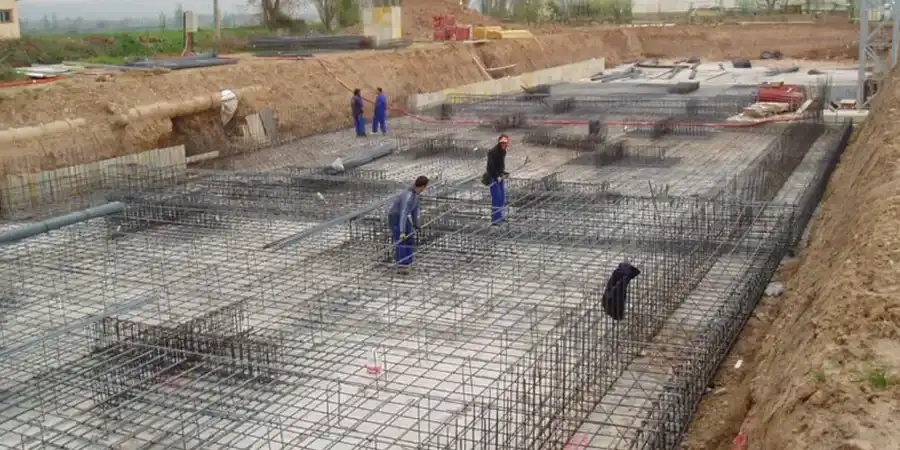
Site-specific factors
With an elevation of just 154 feet above sea level, Shreveport's infrastructure faces chronic hydrostatic pressure and soil saturation risks that directly undermine shallow foundations. The primary failure mode in this region isn't just classic bearing capacity collapse; it’s differential heave caused by moisture migration into highly plastic Yazoo Clay. When a developer overlooks the seasonal volumetric changes in these soils, slab-on-grade foundations crack, and column footings rotate. Our risk mitigation strategy integrates a detailed suction profile analysis and prescribes vertical moisture barriers when necessary, ensuring that the shallow foundation design meets the serviceability limits defined in the current edition of the IBC without relying on excessively deep piers.
Standards used
ASCE 7-22 (Minimum Design Loads and Associated Criteria), IBC 2024 (Chapter 18: Soils and Foundations), ASTM D1586 (Standard Penetration Test), ASTM D2487 (Unified Soil Classification System)
Complementary services
Bearing Capacity Calculation
Analytical solutions using Terzaghi, Meyerhof, and Vesic methods calibrated with site-specific SPT N-values and laboratory shear strengths.
Settlement Monitoring & Prediction
Immediate elastic and long-term consolidation settlement analysis for spread footings on saturated Red River alluvium.
Expansive Soil Mitigation
Design of moisture-conditioned structural fill sections and under-slab vapor retarder systems to combat Caddo Parish's high-PI clays.
Mat Foundation Optimization
Finite element modeling of mat foundations to redistribute column loads and eliminate differential settlement in marginal soils.
Typical parameters
FAQ
What is the typical shallow foundation depth in Shreveport to avoid expansive clay issues?
While frost depth is minimal here, we typically specify a minimum embedment of 18 to 24 inches. The depth is driven less by temperature and more by the active zone of seasonal moisture fluctuation in the Yazoo Clay. Placing the bearing surface below this zone helps mitigate edge heave and center-lift distress in slab foundations.
What is the estimated cost range for shallow foundation design for a commercial site in Shreveport?
For a standard commercial lot requiring geotechnical investigation, lab testing, and engineering calculations, the professional design fee generally ranges from US$1,900 to US$3,100. The final figure depends on the complexity of the soil profile and the number of borings required.
How do you determine if the soil needs a shallow foundation or deep piles?
The decision hinges on the depth to competent bearing strata and the plasticity index (PI). If the undrained shear strength in the upper 5 to 10 feet is insufficient (typically less than 1,000 psf) and settlement exceeds one inch under the design load, we transition the recommendation to a deep foundation system like drilled piers.
Can you design a shallow foundation on the sandy soils near the Red River?
Yes, the alluvial sands and silts near the river often deliver excellent bearing capacity, but they introduce a risk of scour and internal erosion. We perform a specific gradation analysis and apply a scour depth reduction factor to ensure that the footing remains stable during extreme flood events.
What lab tests are critical for shallow foundation design in Louisiana?
We rely on a suite of ASTM-standard tests. Unconsolidated undrained (UU) triaxial tests and Atterberg limits are critical for quantifying the clay's behavior. Consolidation tests (ASTM D2435) are essential to predict time-dependent settlement, which is a major concern in the compressible alluvial deposits of the Red River Valley.