We recently wrapped up testing for a commercial development near the Red River, where the stratigraphy shifts from stiff overconsolidated clays to loose alluvial sands within a few feet. The geotechnical report was due in ten days. A standard unconfined compression test wasn't going to cut it. We needed the full stress path behavior. That's exactly what a triaxial test provides in Shreveport—a controlled method to simulate in-situ confining pressures and understand how a soil element truly fails. For engineers working in the Mississippi Alluvial Plain, where the water table sits high and the soils are notoriously variable, the consolidated-undrained (CU) or consolidated-drained (CD) versions of this test become the backbone of any safe foundation design. Unlike simpler index methods, the triaxial platform lets us isolate the drained friction angle and undrained shear strength under backpressure saturation, parameters that directly feed into slope stability models and deep footing capacity calculations. The lab on Jefferson Paige Road runs these daily, often pairing the setup with undisturbed Shelby tube samples extracted from 30 to 60 feet below the surface.
A triaxial test doesn't just give a number—it reveals the failure mechanism, distinguishing between contractive silts and dilative sands under the exact confining pressure of your foundation.
Process and scope
Site-specific factors
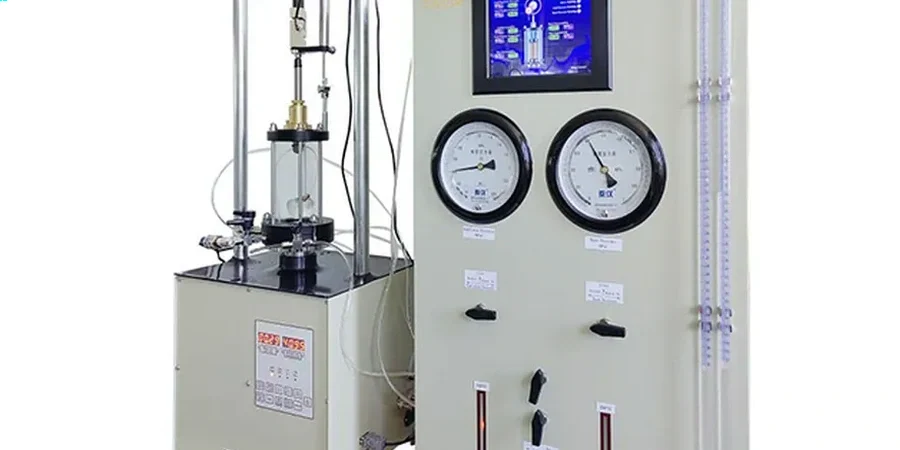
The triaxial cell itself is a heavy-duty stainless steel chamber rated for pressures up to 150 psi, sitting on a loading frame with a precision LVDT and electronic pressure controllers. When a specimen fails in there, it's a silent, sudden shear plane that develops over 15 to 20 percent axial strain. The risk of skipping this test in Shreveport isn't theoretical—it's in the settlement cracks we've seen in older structures along Youree Drive, where foundations were designed using basic bearing capacity equations without site-specific strength envelopes. The high-plasticity clays that dominate the southern part of the city can lose significant strength when remolded or wetted, a behavior only captured through sensitive pore pressure measurement during shear. Without that data, an engineer might overestimate the allowable bearing pressure by 40 percent or more. In deep excavation support, using generic undrained shear strength values instead of triaxial-derived effective stress parameters often leads to overly optimistic wall deflections, which we've had to remediate mid-project with additional bracing and revised construction staging.
Standards used
ASTM D4767 – CU triaxial compression test on cohesive soils, ASTM D7181 – CD triaxial compression test on soils, ASTM D2850 – Unconsolidated-undrained (UU) triaxial compression
Complementary services
Consolidated-Undrained (CU) with Pore Pressure Measurement
The standard for short-term stability analysis in saturated clays and silts. We saturate specimens under backpressure until a B-value of at least 0.95 is reached, then consolidate isotropically to the in-situ effective stress. Shear is conducted at a rate slow enough to allow pore pressure equalization, giving both total and effective stress strength parameters from a single test. This data directly populates the undrained shear strength profile for bearing capacity and lateral earth pressure calculations.
Consolidated-Drained (CD) for Long-Term Conditions
For projects where the permanent water table is controlled by drainage, or for assessing the drained friction angle of sandy and silty materials, we run CD triaxial tests at a much slower strain rate. The volume change is monitored throughout shear, providing the true drained cohesion and friction angle. This is essential for slope stability analyses where pore pressures have fully dissipated, and for designing retaining walls with long design lives.
Typical parameters
FAQ
When does a Shreveport project need a triaxial test instead of a simpler unconfined compression test?
Unconfined compression works for fully saturated, intact clays with zero confining pressure, but in Shreveport's alluvial environment, the water table is often within 10 feet of the surface, and the soils are fissured or interbedded with silt seams. Once a sample is extracted, it can lose suction and swell, giving unrealistically low strengths in unconfined conditions. A triaxial test restores the in-situ confining pressure and backpressure, providing effective stress parameters and a much more reliable undrained shear strength. For any structure with a design life over 10 years, or for slopes and deep excavations, the triaxial platform is the minimum standard per ASTM D4767.
How long does a consolidated-undrained triaxial test take to run?
A single CU triaxial test on a cohesive soil typically takes between 5 and 10 days from setup to final report. The consolidation phase alone can take 48 to 72 hours for high-plasticity clays, and the shear phase runs at a slow rate of about 0.5 to 2 percent axial strain per hour to ensure pore pressure equalization. A multistage test, where one specimen is sheared at three different confining pressures, can compress the total lab time for a full strength envelope into about two weeks.
What sample quality is required for a reliable triaxial test?
The test is only as good as the sample. We require undisturbed Shelby tube or piston samples with a minimum diameter of 2.8 inches and a recovery ratio above 90 percent. Samples should be sealed with wax immediately in the field and transported upright to avoid disturbance. In Shreveport's hot summers, keeping the tubes in insulated coolers during transport is critical to prevent thermal expansion and moisture loss that can alter the soil structure.
What is the typical cost range for a triaxial testing program in the Shreveport area?
A single CU triaxial test with pore pressure measurement generally ranges from US$1.650 to US$2.200, depending on the consolidation stress and saturation requirements. A full program with three isotropic confining pressures, including the geotechnical interpretation report, typically falls between US$2.800 and US$3.070. For multistage testing, the cost is slightly higher per specimen but often saves money overall by reducing the number of samples needed. More info.