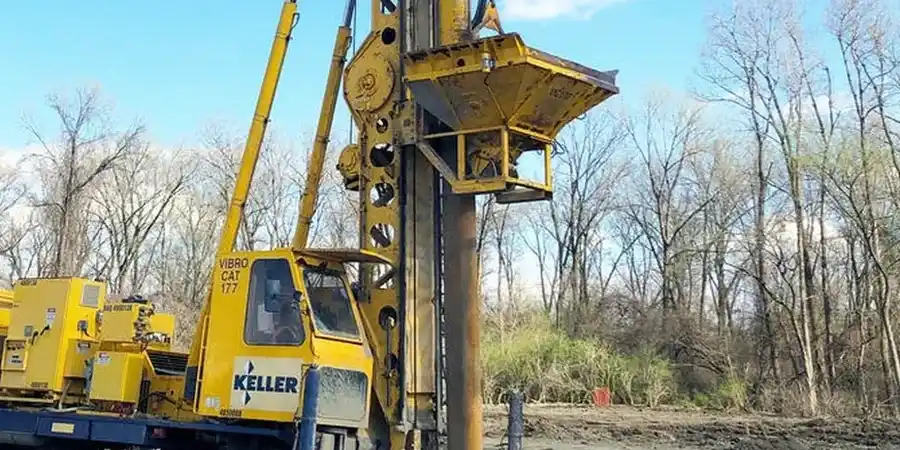
Shreveport's subsurface is shaped by the Red River—miles of point bars, abandoned channels, and layered alluvium that can drop a contractor straight into loose sand at 12 feet. The USGS Quaternary map for this latitude shows Holocene deposits dominating the valley floor, and that means clean sands with SPT blow counts sometimes in the single digits. When a site sits on material that loose, static settlement isn’t the only concern; liquefaction potential under the long-period motion from a New Madrid–sourced event becomes a design driver. Our vibrocompaction design work starts with that reality: we correlate CPT tip resistance and grain-size curves from the grain-size analysis to build a target density profile, then size the vibrator, spacing, and duration to push relative density past 70 percent. In the Caddo Parish corridor, where the water table often sits within 8 feet of grade, the wet top-feed method keeps the hole open while the probe advances, and the CPT test before and after densification gives us a direct before-and-after comparison of the improvement achieved.
In Shreveport’s alluvial corridor, three feet of untreated loose sand can settle more than a properly vibrocompacted 30-foot zone—depth alone doesn’t guarantee performance.
Process and scope
Site-specific factors
A three-story mixed-use building near the Shreveport riverfront taught us what happens when vibrocompaction is treated as a commodity. The original design specified a grid spacing copied from a project in Texas, ignoring the 18 percent silt content in the upper 15 feet. After treatment, CPT readings showed a patchy improvement, with some zones still below 55 percent relative density. We had to remobilize, tighten the grid, and double the compaction time per point—adding weeks to the schedule. The core risk in Shreveport is assuming all alluvial sands behave the same. Silty zones choke pore pressure dissipation, so the probe has to linger longer. Buried organic lenses, common in old meander scars, simply won’t densify and must be removed or bridged with stone columns. And proximity to existing structures demands real-time vibration monitoring; we’ve seen peak particle velocities spike when the vibrator hits a dense paleochannel boundary, and without a pre-condition survey, that can turn into a damage claim before the slab is even poured.
Standards used
ASCE 7-22 Chapter 20 (Site Classification), ASTM D1586 / D6066 (SPT and energy correction), IBC 2021 Section 1805 (Dampproofing and Subsoil Drainage), ASTM D5778 (CPT electronic friction cone), ASTM D4253/D4254 (Max/Min index density of sands)
Complementary services
Pre-Treatment CPT and SPT Investigation
We deploy electronic cone penetration testing and standard penetration borings on a 50-to-75-foot grid to map loose zones, measure pore pressure response, and establish baseline tip resistance and friction ratio profiles.
Energy Grid Design and Specification
Using the investigation data, we determine vibrator size, spacing geometry, compaction time per stage, and backfill gradation. The output is a construction specification with acceptance criteria tied to post-treatment CPT.
Post-Treatment Verification Testing
Within 48 hours of compaction, we re-enter the grid with CPT soundings at the centroid of treated cells, comparing pre- and post-treatment tip resistance and sleeve friction to confirm the design relative density has been achieved.
Vibration Monitoring and Settlement Documentation
For sites within 100 feet of existing structures, we install triaxial geophones and record peak particle velocity during compaction. We also establish settlement monuments to track total and differential settlement through structural framing.
Typical parameters
FAQ
How much does a vibrocompaction design package cost for a typical Shreveport commercial lot?
For a standard commercial pad of 1 to 3 acres with pre- and post-treatment CPT verification, the design and testing package typically falls between US$1,650 and US$5,090. The range depends on grid density, depth of treatment, and the number of verification soundings required by the geotechnical engineer of record.
At what SPT N-value does vibrocompaction become necessary under Shreveport conditions?
We start evaluating vibrocompaction when corrected SPT N-values drop below 10 in clean sands within the upper 30 feet, or when a liquefaction triggering analysis under ASCE 7-22 shows a factor of safety below 1.2. The Red River alluvium in Shreveport frequently shows N-values of 4 to 8 in the 10-to-25-foot zone, which almost always requires densification for structures in Seismic Design Category C or higher.
Does vibrocompaction work in silty sands, or do I need stone columns?
Vibrocompaction works in silty sands up to about 15 to 18 percent fines content, but the compaction time per point increases and the grid spacing tightens. Above that threshold, pore pressure cannot dissipate fast enough for effective densification, and we transition to a stone column or aggregate pier solution. We make that call based on grain-size curves and CPT pore pressure dissipation tests run during the initial investigation.