Pavement design in Shreveport operates under a specific geotechnical reality: the Red River alluvial plain deposits expansive, high-plasticity clays that lose significant strength when saturated. ASTM D1883 remains the standard reference for laboratory CBR determination, but the Louisiana DOTD supplements it with modified compaction protocols tailored to local soils. The city's average annual rainfall of 51 inches means that soaked CBR values—not as-compacted numbers—govern the pavement structural design. Our laboratory runs both standard and modified Proctor-compacted specimens, with a mandatory 96-hour soak period, before applying the penetration piston at 0.05 inches per minute. The resulting load-penetration curve often reveals corrected values below 3.0 on untreated subgrade, a threshold that triggers the need for lime stabilization or a thicker aggregate base layer. For projects near Cross Lake or the industrial corridor along I-20, we frequently pair the laboratory CBR with a field sand cone density verification to confirm that compaction targets are achievable with the specified moisture conditioning.
A soaked CBR value of 2.5 on Shreveport's alluvial clay is not an anomaly—it is the design condition that separates a 20-year pavement from a 5-year failure.
Process and scope
Site-specific factors
Shreveport's development pattern—expanding southward into the soft clays of the Red River floodplain and westward toward the higher Pleistocene terraces—creates a sharp contrast in subgrade bearing capacity across short distances. A pavement section designed for the silty sands of the terrace deposits can fail catastrophically when applied to the expansive valley clays just a mile away. The primary risk is differential heave and subsequent softening: soils with a plasticity index above 30 absorb water through cracks in the pavement edge, swell during the wet season, and then collapse structurally when traffic loads are applied to the now-saturated subgrade. A laboratory CBR test run without proper soaking will overpredict the supporting value by a factor of two or three. This explains why some subdivisions in south Shreveport required premature overlays just three years after construction. The Louisiana DOTD pavement design manual explicitly requires the soaked CBR at 95% of maximum dry density for flexible pavement thickness calculation, and ignoring that requirement—or using unsoaked values to justify thinner sections—is the single most expensive shortcut a project can take.
Standards used
ASTM D1883-21: Standard Test Method for California Bearing Ratio (CBR) of Laboratory-Compacted Soils, ASTM D698 / D1557: Compaction characteristics (Standard and Modified Proctor), Louisiana DOTD TR 415: Laboratory CBR Testing for Pavement Design, AASHTO T 193: The California Bearing Ratio (reproducible procedure, cross-reference)
Complementary services
CBR correlation with field compaction control
We link the laboratory CBR curve to field density acceptance criteria using one-point Proctor verification and nuclear gauge readings. This ensures that the CBR value assumed during design is actually achieved in the compacted lift, particularly for stabilized subgrade layers in Caddo Parish road widening projects.
Stabilizer dosage optimization
For soils with soaked CBR below 3.0, we run parallel CBR specimens with varying percentages of hydrated lime or Type I cement to determine the minimum stabilizer content that lifts the CBR above the 10-15 threshold required by Louisiana DOTD for a working platform.
Typical parameters
FAQ
What is the standard laboratory CBR test procedure for Shreveport projects?
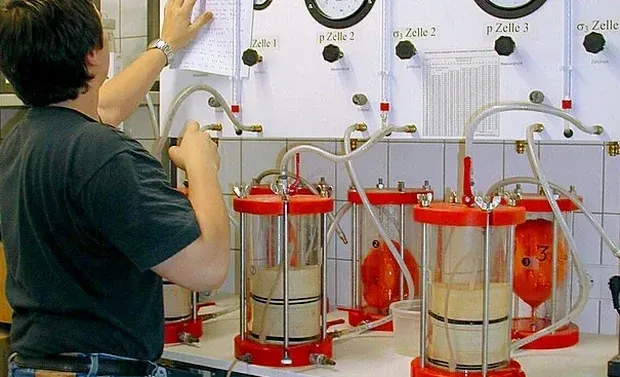
We follow ASTM D1883 with Louisiana DOTD modifications. A soil specimen is compacted at optimum moisture content using the standard or modified Proctor energy, submerged under a 10-pound surcharge for 96 hours, and then penetrated with a 0.05 in/min piston. The corrected CBR is reported at 0.1-inch and 0.2-inch penetration depths. Swell is monitored throughout the soak period using a dial gauge mounted on a tripod.
How much does a laboratory CBR test cost in Shreveport?
A single-point laboratory CBR test, including compaction curve, swelling measurement, and penetration data, typically ranges from US$140 to US$220 per specimen. The exact cost depends on whether standard or modified Proctor energy is required and whether the soil needs stabilizer admixture. A full CBR profile at three moisture points for a single soil type falls at the upper end of this range.
Why is the 96-hour soak critical for Red River Valley clays?
The Red River alluvial clays in Shreveport have a high percentage of montmorillonite, which expands slowly. A 24-hour soak captures only partial swelling and yields an unconservative CBR. The 96-hour protocol mandated by Louisiana DOTD allows the soil to reach near-equilibrium saturation, producing a CBR value that reflects long-term pavement performance. In our track record, the CBR can drop by 40 to 60 percent between 24 and 96 hours.
When should a laboratory CBR test be supplemented with other index tests?
A CBR value alone does not explain why a soil performs poorly. When the soaked CBR is below 5, we recommend running Atterberg limits and hydrometer grain size analysis on the same material. If the plasticity index exceeds 25 and the minus No. 200 fraction is above 60 percent, the soil is highly moisture-sensitive and may require chemical stabilization. In Shreveport, these conditions are common in the backswamp deposits south of downtown. More info.